



















WHICH MOTOR SHOULD I USE?

This material is based on information included in a number of articles and monthly column installments that I have written for model airplane publications including Model Airplane News, S&E Modeler, HIGH FLIGHT, and RCM. It is intended to provide a guide to matching electric motors and accessories to scale radio controlled model airplanes, either those that have been designed originally for glow or gas engines, or new designs that you might want to develop yourself for electric power. Most if not all of it is directly applicable to sport, trainer and aerobatic designs as well as to scale models. I am going to leave discussion of electric power application to high performance sailplanes and high speed pylon race models to the modelers who have extensive experience with them, although what is presented here will certainly get you started if your interest lies in those areas.

HOW MUCH POWER IS THAT ?

Probably the first question modelers ask once they have made the decision to try electric power is also one of the toughest to answer simply. The question is usually put: “What electric motor is equivalent to an “xyz” engine? Because some electric motors are sold with labels that look like glow engine displacements, it is easy to assume that this is a good way to rate them. This is not usually true.

Part of the problem lies in the fact that modelers have been using little internal combustion engines to fly airplanes for over sixty years, and even though the engines have evolved remarkably during that period of time, awareness of what they are capable of has kept pace so that at any given time the average flier knows intuitively what a term like “40-size airplane” means. Because electric power is relatively new, and because there is no single characteristic like displacement that has been used consistently by manufacturers to identify motors, it has been difficult to come up with a standard method for matching motors to models.

Glow engines are usually rated in terms of displacement. When we read engine reviews or the manufacturer’s instructions, we see references to horsepower and to RPM measurements on specific props. More often, we just read the airplane kit box label and pick an engine by matching it to the sizes listed. Since the airplanes we want to convert don’t usually show electric motor sizes on the box labels and newcomers to electric flight don’t have that intuitive “ feel” for power when it comes to electric motors, we need an easy formula to give us answers we can use. The fact is that it isn’t really necessary to worry about glow-to-electric equivalents. All we really want to do is to choose a motor that will make our airplane fly the way it is designed to. This means we need to know how much power the motor will develop. We then need a simple formula to match this power to the airplane of our choice. No one ever figured out a standardized mathematical method, or formula, for doing this with gas and glow engines. Modelers with engineering abilities could always work out power loadings, and so on, but for the average modeler choosing the right engine has always been a matter of reading the sizes on the plan or just good guesswork based on experience. This is why using a formula to choose the correct size electric motor may seem strange to experienced modelers.

Actually, there are already quite a few formulas on hand for determining how much power a motor will produce. They work, but they often appear too involved and may frighten away potential new electric fliers by making electric power seem needlessly complicated. After all, it isn’t necessary to calculate the compression ratio of a new engine to be able to use it! Even so, until you have flown electric long enough that good ol’ experienced guesswork becomes practical, using some kind of a formula makes a lot of sense. I’m going to show you one that is REALLY EASY to use. If you can do Junior High school math, you can do this. What’s more, it really works!

This formula is based on work done by pioneer electric flier Dr. Keith Shaw. I am going to present it in a simplified form. Those of you who are comfortable with the engineering principles involved, and those who have lots of experience with electric power, may argue that I have left out important variables. In fact, my intent is to present a largely empirical, non-threatening approach to matching power to airplanes that works within defined limits to get new electric fliers into the air. It can be argued, perhaps with a bit of humor, since model airplanes are in most cases built by non-certificated individuals using non-standardized materials, under widely varied conditions, that the margin for error in any serious calculation might exceed the entire range of some of the variables. In fact, model airplane building is a pursuit that ranges all the way from casual hobby activity to the level of a true art form. Those who choose to do so may elect to explore more sophisticated methods of calculating performance, while the majority of model builders will probably be satisfied to accept a more simplistic approach and indeed take pleasure in trial and error refinements once their models have begun to fly acceptably.

We’ll start by assuming that you’re using an existing plans-built or kit design. This makes it reasonable to assume that the airplane will be capable of controlled flight, and gives us a ready-made weight (or wing loading) target. Regardless of how the airplane is powered, if the wing loading is maintained within design limits, the glide performance (the landing characteristics of the airplane), is not going to change. We know from experience that good building practices such as careful sanding and replacing needlessly heavy wood with lighter material will keep the weight of our electric conversion at or only slightly above that of the glow engined version. Lots of experience allows us to predict that we can expect a weight gain of no more than 10-15%, and that it is very uncommon for this to be a problem. Indeed, there are many instances of electric conversions of kits intended for glow engines being completed with NO weight increase over the advertised figures. If weight, (and hence the wing loading and the power-off characteristics of the airplane) can be dismissed as a source of difficulty, we can concentrate on making sure we have enough power to take off and perform the way we want.

So, where do we start? Electric motor power is usually expressed in WATTS. This is just another way of talking about horsepower. (1 horsepower = 746 watts) Power in watts is defined as the product of voltage available to a motor times the amps (current) drawn. For instance, if we have a 10 volt battery pack and the motor draws 25 amps, we have 10 x 25=250 watts of power. There’s nothing scary about that!

Keith Shaw’s formula provides a table of performance for airplanes based on the INPUT WATTS of power available to the motor. That is, we are concerned only with the nominal, or spec sheet characteristics of our equipment, and not with all those performance factors and loss coefficients that can scare us off. What we are doing is using readily available information to predict our new airplane’s performance by comparison with data that has proven accurate for lots of other airplanes.

Keith’s formula tells us that for an R/C model airplane that is capable of flight; that is, balanced, trimmed and with a wing loading that will allow it to glide (and land) acceptably, the following numbers are reliable: At least 50 watts of input power per pound of airplane weight will allow a takeoff and safe flight. 60 watts of input power will allow basic aerobatics, and 70 watts (or more) per pound will allow aggressive aerobatics.

How do we get these numbers? First, we know that the nickel-cadmium cells (NiCd’s) we use are rated at a nominal 1.2 volts per cell. For a number of reasons, it makes sense to do our calculations using a figure of 1.1 volts. (Some modelers use an even more conservative approach and base their calculations on 1.0 volts per cell.) So, we multiply the number of cells in the battery pack by 1.1 and get our formula voltage. What about amps? Since we are still figuring out which motor to buy, we can’t very well hook it up and check the current draw with a meter. What we can do is look at the specs the manufacturer advertises, and see what the recommended max current draw at full throttle static is supposed to be. This number gives us what we need to know. Not all manufacturers make this data easy to find. Astro Flight provides excellent lists of current ratings (as well as input power numbers!), but not everyone else is as helpful. Here’s an easy way around that problem. Any of the better quality motors are capable of handling AT LEAST 25 AMPS sustained load. Some examples include such products as the Astro Cobalt brushed motors, any of the brushless motors sold by MaxCim and Aveox, , and the better quality ferrite magnet motors such as the MEC Turbo series, as well as a number of high quality motors imported from Europe. Most will handle more current, but if you calculate performance based on 25 amps, your results will be on the conservative side, and your surprises will be good ones. I would suggest that you use this approach to close in on a likely choice, then make a point of getting specific data on the motor you think will work and doing a final check before spending money!

Let’s try it on a model most of us are familiar with, such as one of the several J-3 Cub kits in the 75” to 80” span range. Seven pounds is a reasonable weight to aim for based on data in the ads and familiarity with a lot of finished models. The Cub is a proven flier, so if we can meet this weight goal then glide and landing performance are guaranteed. We then know that if we have sufficient power, we’ll have a good-flying airplane. We don’t expect to burn up the sky with this plane, but would like to be able to do nice loops and rolls, so we’ll pick a power level figure of 65 watts per pound. At 7 pounds, we need 7x65=455 watts of input power. If we assume that any motor we are going to consider will work at 25 amps or better, then we can calculate that 455 watts divided by 25 amps=18.2 volts. Remembering that our NiCd’s, as well as the newer NiMH cells, actually work under load at about 1.1 volts per cell, we divide 18.2 by 1.1 and get 16.5. This what we’ve been looking for!. A motor that is happy working at 25 amps or better and that is rated for 16-17 cells will do what we want. A good example of a readily available motor that will do the job is the geared Astro Cobalt 25.

The Astro 25 is rated for 14 to 16 cells on the “standard” Astro gearbox, which we’ll talk more about in a bit. The Astro 40, which is rated at 18 to 22 cells, is another option if we want extra power at the expense of a little more weight. I have in fact flown several Goldberg Cubs on geared Astro 25 / 16 cell combinations, both on wheels and on floats, with excellent results. There are a number of other motors on the market that will work as well. This is where you start reading the ads and retail catalogs with confidence that you know what you are looking for, and start comparing product features and prices.

Once you have installed a particular motor in your model and gotten some experience flying it, you can fine tune performance. Increasing voltage by adding one or two cells is often a practical option, as is increasing current draw by using the next higher pitch prop, such as a 13-8 in place of a 13-7. You might also want to de-tune the combination, as in the case of a slow, draggy WWI scale model that can’t use all the speed potential of a higher pitch prop. In such a case you might change to a bigger diameter, lower pitch prop to avoid wasting power at high throttle settings.

Let’s look at several other “gas kit conversion” airplanes that fly well on electric power and see how they illustrate application of the formula:.

Piper PA-12 (1/4 scale) converted from the Sig kit: wing area =1600 sq. in.; weight = 19 pounds. Geared Astro 90 on 35 cells draws 33 amps. Wing loading =27.4 oz. / sq. ft. (this is light-to-moderate for this size airplane). Power loading =67 watts/pound. This is consistent with the better-than-scale aerobatic capability demonstrated by the airplane.

Spitfire (1/5 scale) converted from the Dynaflite kit: wing area = 1150 sq. in.; weight =15 pounds. Geared Astro 60 on 32 cells draws 32 amps. Wing loading = 30.4 oz. /sq. ft. (consistent with fighter-type handling in this size airplane) Power loading = 77 watts/pound. Performance bears out the prediction that this is an aggressive airplane.

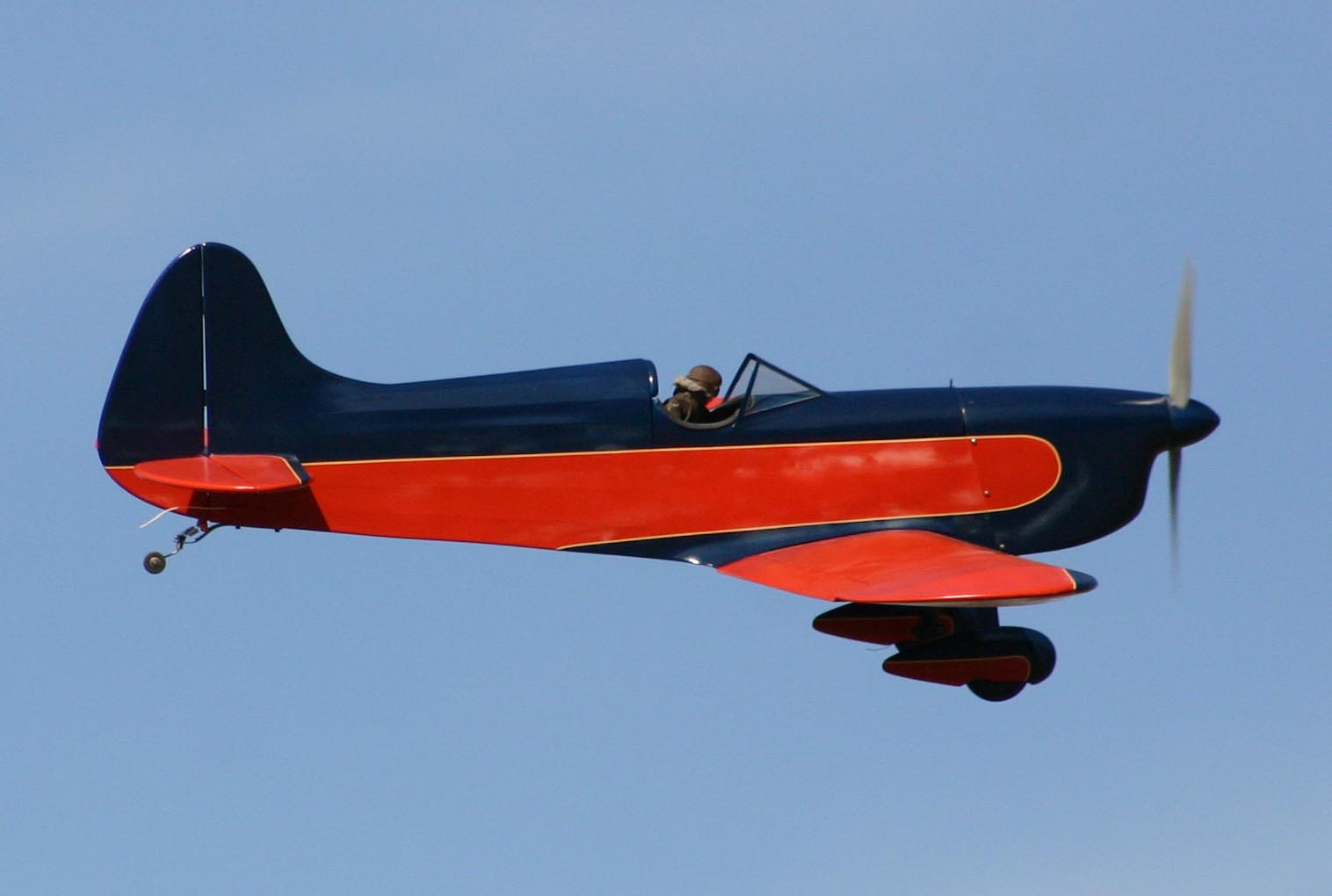
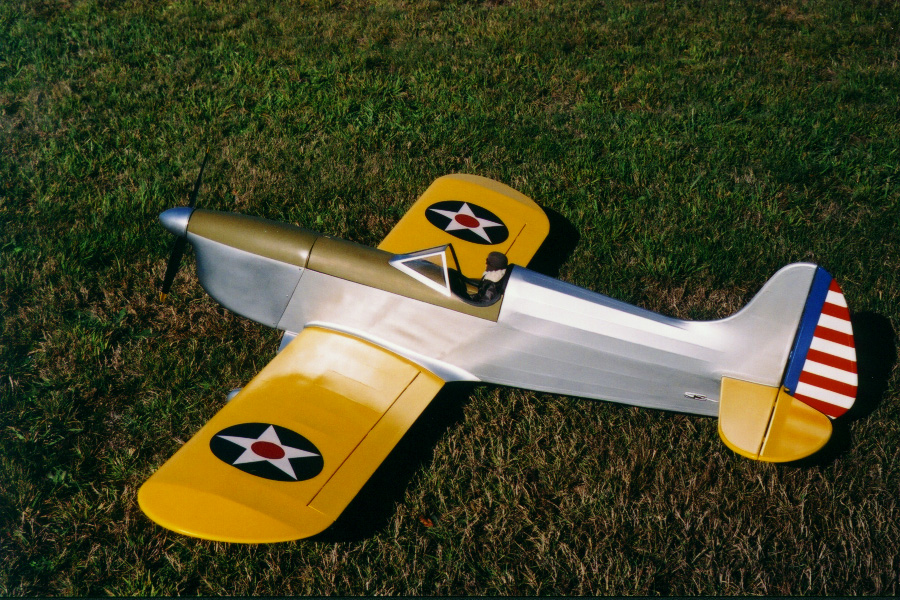
Starduster “40 size” low wing sport aerobatic model converted from the Midwest kit: wing area = 665 sq. in; weight = 5 lb. 7 oz. A Model Electronics Turbo 10 Plus geared at 6-1 running on 10 cells and drawing about 35 amps on a 12-8 prop provides a power loading of 71 watts per pound. In the lightly loaded (18.9 oz./sq. ft.) Starduster this equates to very good sport aerobatic performance.

WHAT KIND OF MOTOR IS BEST ?

Even though electric power is not yet accepted by many modelers, you will see advertising for a wide range of electric motors and related equipment once you start looking for it. I will offer some very broad general guidelines to help you make choices. First, it helps to realize that in this game you get what you pay for. At the inexpensive end of the scale are the ferrite magnet brushed motors. R/C car motors fall into this category. Most are designed to run on what are, by airplane standards, low cell counts (6 to 10). Most are intended for relatively low current (below 20 amps) and will not stand up under prolonged running at higher current levels or high operating temperatures.

All things being equal, most ferrite magnet brushed motors will not provide the same airplane performance on a given battery pack as a “rare earth” (usually cobalt) magnet motor. These motors are usually built to higher standards and operate at higher current levels and with much better heat tolerance. While there are many small cobalt motors designed for the same cell counts as the popular car motors, there are also larger versions, running on battery packs of up to 40 cells, that can easily match the power of very large glow engines . Brushless motors are the high - tech end of the spectrum. As the name implies, they do not rely on physical contact of a conductive “brush” with a commutator, but rather use solid state electronic switching to control current flow within the motor. They are the most efficient option available to us at this time, and can outperform brushed cobalt motors on equivalent battery packs.

Each type of motor has an appropriate application. For the modeler who prefers small. models or who may have limited money to spend, inexpensive ferrite motors can provide excellent results if used properly. They can be made to fly very lightly built airplanes quite well. Although they are most often advertised and sold for direct drive applications, they usually perform better when matched to an appropriate gearbox or belt drive. Most new electric fliers have the best results with geared, brushed cobalt magnet motors flying mid – size airplanes. If you can afford them, brushless motors are the class act. They are available in a very wide range of sizes to fit just about any airplane you might want to build, but they might not be the best choice for a trainer that is likely to be subjected to rough treatment. My suggestion is that you gather ad material and catalogs from manufacturers whose products interest you and make a decision based on their specifications and the information provided here.

WHAT ABOUT “BATTERIES” AND CHARGERS ?

When much of this material was first written, Nickel – Cadmium (NiCd) cells were the power source of choice for electric flight. There is a wide variety of NiCd cells on the market. Only those intended for rapid charging and high discharge currents are suitable for use in electric flight motor batteries. There are a number of suppliers offering motor battery cells to the model aviation market; all their products work. Buy battery packs intended for electric power use from them, and rest assured that the performance will be what you expect. The “sub C” cell has become the “standard” size. Most sub C’s sold today are of 2000mAh (milliampere hour) capacity. Smaller cells (with reduced current capacity) are available for use for very small models. If you are interested in models of “.20” size (about 350 to 400 sq. in. wing area) or larger, use sub C’s and don’t worry about the smaller cells.

A lot of attention is being generated by new cell types that are claimed to offer lots of power (duration) in very small packages compared to NiCd”s. For the most part these cells cannot yet deliver current at high enough rates to be useful as electric flight power sources. The happy exception is the Nickel Metal Hydride (NiMH) cell. At the time this material was first being prepared these had just become available to modelers in a form that provides excellent current output performance. Since that time I have had the opportunity to fly the 3000 mAh sub “C” cells on many occasions and indeed watched George Maiorana’s TU-4 put on a spectacular performance at Scale Masters 2000 using them. They perform just as advertised if you read the directions and use them accordingly, and offer a dramatic improvement in flight duration for a given motor battery volume and weight.

Various pack assembly techniques are available. Cells can be assembled into battery packs using welded straps, soldered braid connectors, or in “solderless” tubes. All the methods work, and I will suggest that you begin with whichever system is offered where you purchase your motor and other accessories. When you have some electric flight experience, you can decide which works best for your particular interests.

In R/C aeromodeling applications, NiCd and NiMH battery packs are always assembled, run and charged in series. Several manufacturers offer good quality chargers designed to fast - charge motor battery packs “in the field” as well as in your shop. Buy the best you can afford. Any charger you choose should be of the type known as “peak detecting”; this means that it automatically turns itself off when the battery is fully charged. The better models include a digital readout that tells you things like the charging voltage and current, and records how long your pack was on charge. Having this capability is worth the price. When you choose a charger, pay attention to the maximum cell capacity. Many inexpensive chargers designed for the model car market are limited to seven cell packs. Give some thought to the size model you are likely to be flying next year, and get a charger that will meet your needs then. The best chargers on the market today will handle up to 36 cells.

Virtually all of these chargers are designed to operate from a 12 volt automotive battery. This can be either the one in your car, or a separate unit dedicated to field charging. If you use a separate battery, get a “deep cycle” type, as an ordinary automotive battery is not designed for the deep discharge that occurs without your car’s alternator constantly recharging it as load is applied.

PROPELLER SPEED REDUCTION

You may not be familiar with what motor gearing is, or understand why it is used so often. Engineering data predicts, and the experience of a lot of electric fliers verifies, that the electric motors we use to fly our models usually work a lot better if they are equipped some sort of reduction drive that allows the propeller to turn at a speed slower than that of the motor armature, or output shaft. The exceptions to this rule, airplanes such as very high performance sailplanes and pylon racers, are fast enough that their flight speeds are compatible with the propeller RPM’s ( usually well above 10,000) generated when small props are mounted directly. The majority of scale models do not fall into this category, but are what we can think of as low or moderate speed airplanes. Without getting into lots of deep math, we have sufficient experience to justify an assumption that a big prop turning at moderate RPM, in the range of 3500 to 7500, will fly the kind of models we are interested in better and more efficiently than a small prop turning at high RPM.

What we do about this is to mount a reduction device, in the form of a gearbox or belt drive, to our motor to allow a big prop to turn at a slower, more efficient speed. This has the added good effect of allowing the motor to unload and turn faster. This is more efficient from the motor’s point of view. You can see an excellent analogy to this arrangement in a full scale turboprop engine. I’ll leave it to the motor experts to explain why electric motors like this so well and get on with sharing with you some of the ways you can achieve this “fast motor - slow prop” combination. Several manufacturers offer a wide variety of prop speed reducers. Only a few years ago this was not the case, and the choice was very limited. One of the first series of really good quality gearboxes was offered by Astro Flight. Here are some examples of gearbox options based on the Astro flight product line. The relationships illustrated apply to other manufacturer’s products as well.

Astro Flight produces motors in a wide range of sizes, including the new brushless 010 and the 020, which comes with its own dedicated gearbox, and brush-equipped motors ranging in size from the 035 to the 90.These can be set up to produce power equivalent to glow engines ranging from 2 - stroke .049’s to 1.60 or larger four - strokes. For many years Astro has offered gearboxes in three sizes. The smallest fits the 035, the 05 and 15 motors. The next size is matched to the 25 and 40 models, and the largest is designed to work with the big 60 and 90. These “standard” gearboxes are set up for relatively low reduction ratios. The small size runs at 2.38 to 1, the 25 - 40 box is set at 1.82 to 1, and the 60 - 90 box provides a 1.63 to 1 reduction. All are designed with a fixed gear ratio that is not user - adjustable. These ratios work very well for many different models, but it became obvious as modelers began to experiment with an ever - wider range of airplanes in increasingly large sizes that higher reduction ratios would enable the Astro motors to fly much larger airplanes than was practical with the standard gearboxes. The result was a new “Super Box” product line offering higher gear ratios on the order of 3 to 1 that allow Astro motors to turn very large props at lower speeds. For example, Astro’s largest production motor, the Cobalt 90, can handle props as large as 28x14 on these gearboxes.

Let’s have a look in detail at what happens when we operate a representative motor direct drive and then with various ratio gearboxes. The Astro 25 is a popular motor, about midway through their size range, and one with which I have had a lot of experience. Using the advertised characteristics of the motor from the factory “spec sheet” (numbers which are substantiated by my experience and that of many fellow fliers), we can draw some comparisons and make some predictions about equipment applications for our airplanes. All performance numbers are based on Astro’s recommended best voltage and static current; that is, a 16 cell battery pack and 26 amps in the case of the direct drive and the “standard” gearbox, 30 amps using the 3.1 to 1 ratio Super Box.

A simple “pitch speed” formula, shows that the recommended 9-5 direct drive prop turning at 13,500 static RPM will yield a theoretical top flight speed of about 67 mph while the motor is producing 350 watts. If we use the “standard” 1.82 to 1 gearbox and the recommended 11-8 prop, which should turn at about 8200 RPM, we get a flight speed of about 63 mph, again at 350 watts. Using the 3.1 to 1 ratio Super Box and a 16-8 prop, we expect about 5000 RPM, this time with about 550 watts generated and a flight speed of about 44 mph. It’s not hard to see how the direct drive set-up might work best with a smaller, well streamlined model that would be happy with the high speed airflow generated by the small prop turning at 13,500 RPM, and that the standard geared setup might work better for a fatter, slower airplane. Likewise, if we have a big, slow model we can predict that the 3.1 ratio gearbox and that 16” prop would be the way to go. BUT, that’s not the whole story! Thrust generated when the motor turns the prop and moves air is what makes our airplane go. Thrust can be defined as the product of the amount of air moved times the speed at which we move it. (Mass multiplied by velocity) We haven’t yet looked at the mass, or amount of air, that is involved when we use a gearbox and a bigger prop. Using simple geometry, we can show that the 11” prop on the 1.82 ratio gearbox moves about 150% of the air moved by the direct drive prop, and the 16” prop on the 3.1 ratio gearbox moves 210% of the air the 1.82 ratio unit can handle, and 315% (!) as much air as is used to make thrust by the direct drive setup! For the kind of airplanes we are dealing with here, there’s something to be said for using the biggest prop our motor - gearbox combo can handle efficiently.

Here’s a simplified approach to deciding where to start in choosing prop speed reduction:

DIRECT DRIVE: Racing (pylon) models and high performance electric powered sailplanes that are happy going fast.

LOW REDUCTION RATIOS: Scale models of high performance airplanes such as fighters, as well as many trainers and sport and aerobatic models with fighter type characteristics. These are generally medium speed models.

HIGH REDUCTION RATIOS: Scale models of lightplanes, WWI and Golden age subjects, and large, light sport models such as old timers, that are happy flying slowly.

BELT DRIVES

All of the relationships described above apply to belt drives as well. The units manufactured by ModelairTech are probably the most common on today’s market. The most obvious advantage of using belt drives is that with a wide range of manufacturer-supplied components, the user can easily select the reduction ratio that best fits his own airplane. By the same token, the design concept used allows virtually any motor in the intended size range to be mounted. ModelairTech’s belt drives are supplied with clear instructions including full size drawings which make it just about impossible for the modeler who pays attention and works carefully to get into trouble with assembly and operation. A feature of belt drives not shared by gearboxes is that direct drive motors being converted to belt reduction need not be reversed and retimed, as the output shaft rotates in the same direction as the motor.

Belt drives offer a couple of other advantages that aren’t immediately obvious. ModelairTech’s output shaft, which is supported by two sealed ball bearings, is supplied longer than will be needed for most installations. Provision is made for the modeler to trim the shaft for an exact fit in his particular airplane, without compromising critical parts of the drive unit. Because the entire assembly is “open”, with space around individual components, and the belts are flexible, these drives are less susceptible to “foreign object damage” than are gearboxes. Mounting for the motor is designed into the belt drive assembly, and the entire assembly is then attached to mounting beams built into the airplane using ordinary modeling materials and techniques. In getting all this flexibility, it is necessary to accept a compromise in the form of a somewhat bulky unit with a slightly greater motor - to - thrustline offset than is usual with gearboxes. As the great majority of scale models have cowls that are relatively large in comparison to our motors, this doesn’t usually present a problem.

ModelairTech offers the comment that at the speeds most scale modelers will run their systems, there appears to be no efficiency advantage for either gearboxes or belt drives.

Gearboxes do appear to be a better choice where high sustained motor RPM’s will be used. They suggest 15,000 motor RPM as a max safe sustained speed. All considered, the degree of flexibility in reduction ratio and mounting options make these belt drives a good choice for many large models that won’t be expected to go really fast.

WHERE DO I GET THIS STUFF ?

Because a majority of the hobby shops and mail order model airplane suppliers in the U.S. still do not understand the potential of electric flight, modelers often find it difficult to purchase electric flight equipment. The answer for now is to deal with the specialized mail order shops that support electric flight activities. I suggest that you check out all those whose ads you find in the various magazines. To get you started, we recommend one without reservation. Contact Kirk Massey’s New Creations R/C, P.O. Box 496, Willis, TX 77378 (409) 856-4630. You can trust Kirk to set you up with the right stuff, the first time, at a good price.


LET’S GO FLYING…I’ll see you at the field…Bob Benjamin